Influencer platforms compared: This is how you find the right tool in 2026.
Influencer platforms compared: This is how you find the right tool in 2026.
Jennifer Geithner •
December 3, 2025
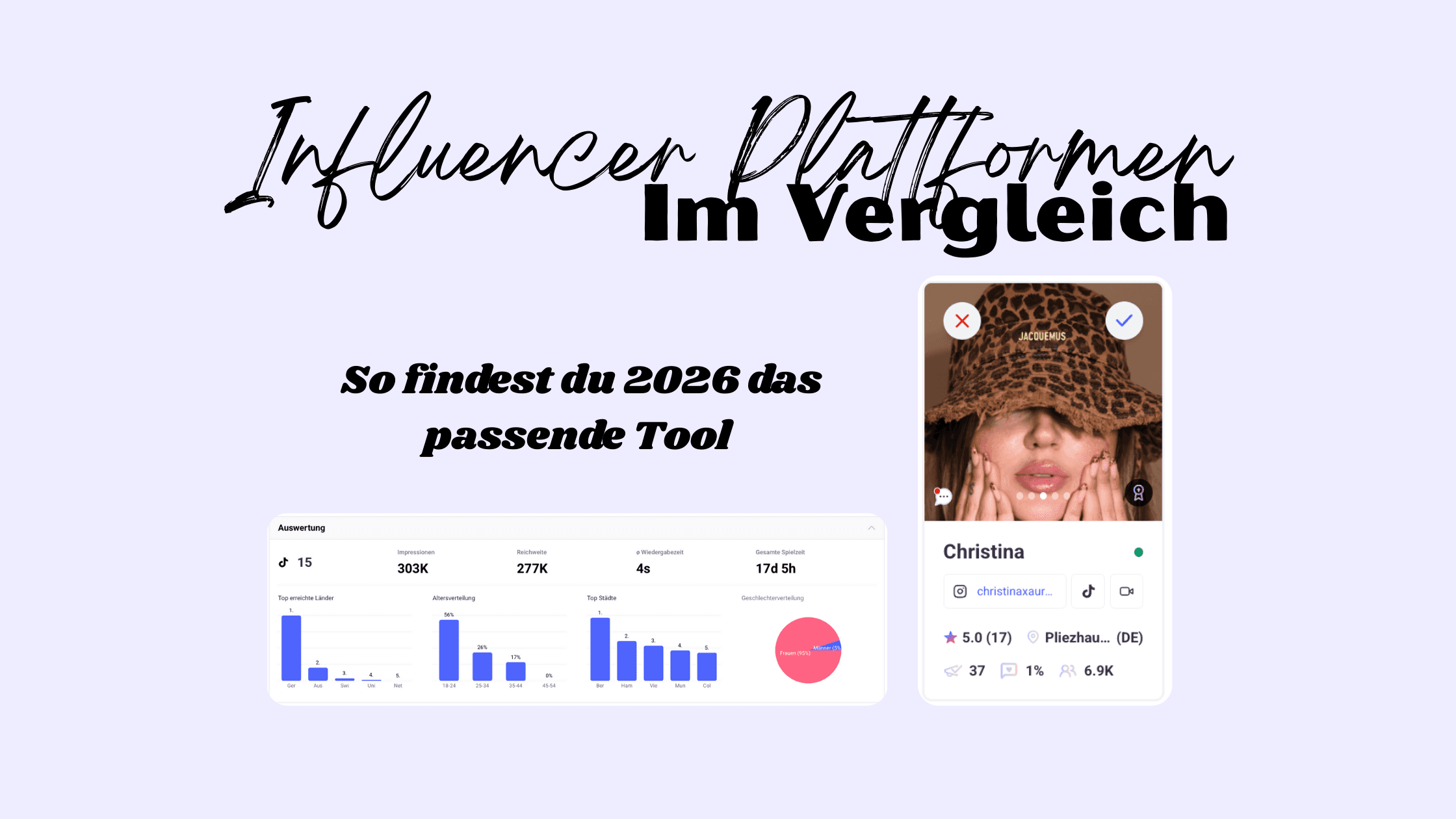
Influencer marketing is growing rapidly – and with it the number of tools that promise to make everything simpler. But in everyday life, one thing matters most: How quickly and clearly does a platform take you from idea to running campaign, without bogging your team down with unnecessary complexity?
Here is where influencer platforms differ more clearly than ever today. Some provide strong data, others shine at user-generated content (UGC) or customer relationship management (CRM), and some leverage an automated flow that takes real work off your hands.
In this article, you will get a clear overview of the most important platforms for 2026, their strengths, and areas of application, so you can find the tool that truly fits your goals.
What makes a good influencer platform in 2026
Influencer marketing has evolved significantly in recent years – and expectations for platforms have risen accordingly. Good tools today don’t just solve isolated tasks; they keep the entire process together. And that’s exactly where their quality is determined.
Clear, accurate matching: In 2026, it’s no longer about listing as many creators as possible. What's crucial is how well a platform understands which creators fit your brand, your target audience, and your campaign goals. Here it’s clear: data quality trumps data quantity.
A workflow that does not slow down: When a tool replaces multiple platforms, you notice it immediately, as briefings are more uniform, agreements are reduced, and content automatically ends up where it belongs. Good platforms do not feel like "just another tool," but rather like a clear process.
Real performance transparency: Likes alone do not drive decisions. In 2026, metrics such as clicks, conversions, net reach, and cost per result matter. The best platforms make this visible – immediately, without manual reporting, without guesswork.
Clear rights, clear data, fair relationships: Modern teams need reliable processes, from rights management to brand safety, fraud detection, and creator histories. Not because it’s "nice to have," but because campaigns become unnecessarily risky without these foundations.
In short: A good influencer platform recognizes what is important before you have to search for it – and ensures that campaigns become not more complicated but clearer.
The most important influencer platforms in 2026
Influencer platforms focus on very different aspects in 2026. The following overview shows where the individual tools have strengths – and for which areas of application they are truly suitable.
1. Refluenced
Refluenced combines AI-driven briefings with an automated campaign flow – and is one of the few platforms that functions as a true two-sided marketplace. Creators use their own app, are verified, and actively apply for campaigns. This creates a high-quality creator pool with genuine intent rather than passively crawled profiles, which brands must manually reach out to and hope for responses.
Content, rights, and performance flow together automatically in a seamless workflow – without tool switches or manual steps.
The results speak for themselves: over 820,000 clicks from 2,813 campaigns, an average CTR of 3%, 34% higher purchase intent, and a 64% stronger campaign impact.
Pros:
AI-driven end-to-end workflow (briefing → applications → content → rights → ads → reporting)
Two-sided marketplace with verified creators and high intent, as influencers actively search for and apply to campaigns via the app
Perfect for ongoing campaigns: ideal for year-round, continuous collaboration with creators
Partnerships and spark ads as well as UGC scaling natively integrated
Cons:
Less suitable for pure celebrity campaigns, as the focus is clearly on nano and micro-influencers
2. Kolsquare
Kolsquare is a data-rich influencer platform focused on analysis, CRM, and precise matching. It is particularly suitable for brands that wish to collaborate with influencers less frequently.
Pros:
Semantic AI search for precise matching
In-depth audience and credibility analyses
Cons:
Somewhat complex interface
No two-sided marketplace → brands must contact influencers manually and hope for responses
Less focus on workflow automation
3. Storyclash
Storyclash is a monitoring and listening-oriented tool, ideal for brands that want to track creator content and brand mentions in detail. The platform is particularly strong in TikTok and Instagram tracking.
Pros:
Real-time monitoring across platform boundaries
Instagram story archive & historical tracking
Cons:
No fully-fledged campaign workflow
Outreach, follow-ups, and negotiations are entirely up to the brands
Creator selection is less thorough than with specialized matching tools
4. Speekly
Speekly is a UGC-first platform that delivers quick video creatives from verified creators to brands. Speekly is particularly attractive for social ads and conversion optimization – but it is more globally oriented and less widespread in the DACH region.
Pros:
Fast & cost-effective UGC production
Full rights to all created videos
Cons:
No classic influencer matching, as creators do not post the produced UGC content on their own social media channels
Not suitable for complex campaigns or creator relationships
5. Boksi
Boksi combines UGC with influencer collaborations and makes it easy to produce content in a structured way and acquire rights directly. The platform is particularly exciting for brands that want to combine organic and paid content.
Pros:
Verified creators + solid UGC production
Clear processes for content acquisition & usage rights
Cons:
Manual outreach processes & more negotiations required
Less functional depth in campaign management
Matching is not as granular as with Refluenced/Kolsquare
6. Iroin
Iroin is a European influencer CRM with a strong data foundation and a high compliance orientation. Ideal for brands for whom GDPR security and data depth are crucial.
Pros:
Huge data foundation (many platforms, EU servers)
Understandable CRM & reporting
Cons:
No fully automated flow
Classic outreach structure: no application principle, more communication effort
More traditionally built, less modern in handling
7. Skeepers
Skeepers connects influencer marketing with social commerce and community approaches. Particularly strong for nano and micro-influencer campaigns as well as product reviews, the platform is especially strong in France and Southern Europe, but less present in the DACH region, which may be relevant for local campaigns.
Pros:
Large community of micro/nano creators
Commerce functions such as TikTok Shop & Instagram Shopping
Cons:
Focus is strongly on reviews & UGC, less on classic influencer campaigns
Less suitable for data-driven performance campaigns
8. Upfluence
Upfluence offers a very large creator database and automation functions for international brands. The platform is robust but often more enterprise-oriented.
Pros:
Wide data base with millions of creators
AI support for discovery & campaign workflows
Cons:
Relatively high entry costs & longer contract duration
More complex in setup & onboarding than lighter tools
Higher effort due to manual outreach, follow-ups, and price negotiations
Deep Dive: How leading influencer platforms really differ
Many influencer platforms appear similar on the surface, but in everyday life, clear differences manifest. The following categories reveal where the tools show their strengths and which platform leads in which discipline in 2026.
Matching – Who delivers the best creator fits?
What it's about: Does the platform find creators who truly fit – based on target audience, content style, campaign type, etc.?
Analysis: Refluenced excels here with a completely different approach: instead of relying on pure search, creators actively apply for campaigns. This results in higher relevance, self-selection, and significantly better matching. The platform also automatically filters target audiences, content quality, and creator history.
Winner: Refluenced
Workflow & Automation – Which platform takes the most work off your hands?
What it’s about: How smoothly does a campaign run from A to Z? How many tools, files, and manual steps does the platform save your team?
Analysis: Refluenced is currently the only platform on the market that offers a completely automated flow – from briefing through applications to content, approvals, rights, and performance. This not only reduces complexity but also significantly accelerates campaigns.
Winner: Refluenced
Data analysis & Reporting – Who helps you make better decisions?
What it's about: How clear, deep, and practical are the insights? Do data actually lead to decisions, or do they remain tables?
Analysis: Kolsquare sets the standard here. The platform offers a very in-depth audience analysis, credibility and compliance scores, as well as a comprehensive reporting system that is particularly valuable for international brands. The data is rich in detail, structured, and analytically strong.
Winner: Kolsquare
Content & Rights – Who keeps order in the creative chaos?
What it's about: How well are content, guidelines, versions, and usage rights organized?
Analysis: Boksi is especially strong here: the platform enables structured content production, clear handover processes, and the easy acquisition of usage rights. For teams prioritizing UGC and smart reuse, this is a significant advantage.
Winner: Boksi
Performance & Real-Time Insights – Who quickly shows you what really works?
What it's about: How precise and up-to-date are the performance data? How well can they be used for optimizations?
Analysis: Storyclash delivers the best real-time monitoring across platform boundaries – including brand tracking, story archiving, and creator insights. Particularly for data-driven brands with a focus on social listening, Storyclash is a good choice.
Winner: Storyclash
Scalability – Which platform works for many campaigns as well?
What it's about: Does the effort per campaign remain low – or does it grow with each additional creator?
Analysis: Refluenced scales through automation instead of team size. Since applications, content flows, and approvals operate automatically, the effort remains constant, even with a very large number of creators.
Winner: Refluenced
Overall Winner 2026: Refluenced
Refluenced does not win in all categories – but in the categories that make the greatest difference in everyday life: matching, workflow, and scalability.
While other platforms solve individual tasks well, Refluenced creates something crucial: it connects everything. From briefing to scaling – without tool switches, without chaos, without unnecessary steps.
That’s precisely why Refluenced is the top choice for brands and agencies in 2026, who do not simply want a tool, but a campaign flow that works.
How to find the right influencer platform in 2026: Decision Framework
Before you compare tools or book demos, it’s worth a quick reality check. The right influencer platform is always the one that fits your goals, your team, and your campaign style. These four questions will quickly guide you in the right direction.
1. What do you actually want to achieve?
Are you aiming for reach, performance, UGC, paid social, or long-term creator relationships? The platform you choose should support this specific focus.
2. How much operational capacity do you really have?
If your team is small or numerous campaigns are running concurrently, you need automation instead of features. If you want to deeply analyze data, you need a tool with a stronger analytics focus.
3. How complex are your campaigns?
Simple UGC content? → UGC platforms.
Multi-stage creator campaigns? → Workflow-oriented tools.
High volume & international markets? → data-driven enterprise solutions.
4. How much routine work do you want to do in the future?
This question separates platform types the most. If you want to search less, sort less, follow up less – then automation is the central factor. And thus the direction is clear.
Frequently Asked Questions (FAQ) about influencer platforms in 2026
What makes a good influencer platform in 2026?
A good influencer platform offers reliable matching, automated workflows, and transparent performance data. More important than large databases is a clear, stable process that simplifies campaigns from briefing to reporting. Platforms like Refluenced focus on end-to-end automation and noticeably save teams time.
Do brands absolutely need influencer platforms in 2026?
Yes – especially when dealing with multiple creators or more complex campaigns, an influencer platform is indispensable. Matching, content handling, rights, and reporting are hardly efficient when done manually. Influencer platforms drastically reduce this effort.
Which influencer platform is the best for brands with multiple campaigns in 2026?
For parallel campaigns, platforms that reduce operational work and reliably automate recurring steps are particularly suitable. Refluenced is especially strong here, as matching, content, rights, and performance flow together in a seamless workflow. This ensures clear processes and makes the platform ideal for brands looking to scale their influencer marketing without additional team effort.
Conclusion: The best influencer platform does not feel like a tool – but like a flow
In 2026, the feature set of an influencer platform matters less than the question of how clearly and smoothly it carries campaigns. The tools on the market set different priorities – data, monitoring, UGC, CRM. Refluenced shows what influencer marketing looks like when everything comes together: an automated flow that connects creator fit, pace, and scalability.
Start a campaign via Refluenced, if you want to experience what influencer marketing feels like when the process finally cooperates instead of slowing down.
Influencer marketing is growing rapidly – and with it the number of tools that promise to make everything simpler. But in everyday life, one thing matters most: How quickly and clearly does a platform take you from idea to running campaign, without bogging your team down with unnecessary complexity?
Here is where influencer platforms differ more clearly than ever today. Some provide strong data, others shine at user-generated content (UGC) or customer relationship management (CRM), and some leverage an automated flow that takes real work off your hands.
In this article, you will get a clear overview of the most important platforms for 2026, their strengths, and areas of application, so you can find the tool that truly fits your goals.
What makes a good influencer platform in 2026
Influencer marketing has evolved significantly in recent years – and expectations for platforms have risen accordingly. Good tools today don’t just solve isolated tasks; they keep the entire process together. And that’s exactly where their quality is determined.
Clear, accurate matching: In 2026, it’s no longer about listing as many creators as possible. What's crucial is how well a platform understands which creators fit your brand, your target audience, and your campaign goals. Here it’s clear: data quality trumps data quantity.
A workflow that does not slow down: When a tool replaces multiple platforms, you notice it immediately, as briefings are more uniform, agreements are reduced, and content automatically ends up where it belongs. Good platforms do not feel like "just another tool," but rather like a clear process.
Real performance transparency: Likes alone do not drive decisions. In 2026, metrics such as clicks, conversions, net reach, and cost per result matter. The best platforms make this visible – immediately, without manual reporting, without guesswork.
Clear rights, clear data, fair relationships: Modern teams need reliable processes, from rights management to brand safety, fraud detection, and creator histories. Not because it’s "nice to have," but because campaigns become unnecessarily risky without these foundations.
In short: A good influencer platform recognizes what is important before you have to search for it – and ensures that campaigns become not more complicated but clearer.
The most important influencer platforms in 2026
Influencer platforms focus on very different aspects in 2026. The following overview shows where the individual tools have strengths – and for which areas of application they are truly suitable.
1. Refluenced
Refluenced combines AI-driven briefings with an automated campaign flow – and is one of the few platforms that functions as a true two-sided marketplace. Creators use their own app, are verified, and actively apply for campaigns. This creates a high-quality creator pool with genuine intent rather than passively crawled profiles, which brands must manually reach out to and hope for responses.
Content, rights, and performance flow together automatically in a seamless workflow – without tool switches or manual steps.
The results speak for themselves: over 820,000 clicks from 2,813 campaigns, an average CTR of 3%, 34% higher purchase intent, and a 64% stronger campaign impact.
Pros:
AI-driven end-to-end workflow (briefing → applications → content → rights → ads → reporting)
Two-sided marketplace with verified creators and high intent, as influencers actively search for and apply to campaigns via the app
Perfect for ongoing campaigns: ideal for year-round, continuous collaboration with creators
Partnerships and spark ads as well as UGC scaling natively integrated
Cons:
Less suitable for pure celebrity campaigns, as the focus is clearly on nano and micro-influencers
2. Kolsquare
Kolsquare is a data-rich influencer platform focused on analysis, CRM, and precise matching. It is particularly suitable for brands that wish to collaborate with influencers less frequently.
Pros:
Semantic AI search for precise matching
In-depth audience and credibility analyses
Cons:
Somewhat complex interface
No two-sided marketplace → brands must contact influencers manually and hope for responses
Less focus on workflow automation
3. Storyclash
Storyclash is a monitoring and listening-oriented tool, ideal for brands that want to track creator content and brand mentions in detail. The platform is particularly strong in TikTok and Instagram tracking.
Pros:
Real-time monitoring across platform boundaries
Instagram story archive & historical tracking
Cons:
No fully-fledged campaign workflow
Outreach, follow-ups, and negotiations are entirely up to the brands
Creator selection is less thorough than with specialized matching tools
4. Speekly
Speekly is a UGC-first platform that delivers quick video creatives from verified creators to brands. Speekly is particularly attractive for social ads and conversion optimization – but it is more globally oriented and less widespread in the DACH region.
Pros:
Fast & cost-effective UGC production
Full rights to all created videos
Cons:
No classic influencer matching, as creators do not post the produced UGC content on their own social media channels
Not suitable for complex campaigns or creator relationships
5. Boksi
Boksi combines UGC with influencer collaborations and makes it easy to produce content in a structured way and acquire rights directly. The platform is particularly exciting for brands that want to combine organic and paid content.
Pros:
Verified creators + solid UGC production
Clear processes for content acquisition & usage rights
Cons:
Manual outreach processes & more negotiations required
Less functional depth in campaign management
Matching is not as granular as with Refluenced/Kolsquare
6. Iroin
Iroin is a European influencer CRM with a strong data foundation and a high compliance orientation. Ideal for brands for whom GDPR security and data depth are crucial.
Pros:
Huge data foundation (many platforms, EU servers)
Understandable CRM & reporting
Cons:
No fully automated flow
Classic outreach structure: no application principle, more communication effort
More traditionally built, less modern in handling
7. Skeepers
Skeepers connects influencer marketing with social commerce and community approaches. Particularly strong for nano and micro-influencer campaigns as well as product reviews, the platform is especially strong in France and Southern Europe, but less present in the DACH region, which may be relevant for local campaigns.
Pros:
Large community of micro/nano creators
Commerce functions such as TikTok Shop & Instagram Shopping
Cons:
Focus is strongly on reviews & UGC, less on classic influencer campaigns
Less suitable for data-driven performance campaigns
8. Upfluence
Upfluence offers a very large creator database and automation functions for international brands. The platform is robust but often more enterprise-oriented.
Pros:
Wide data base with millions of creators
AI support for discovery & campaign workflows
Cons:
Relatively high entry costs & longer contract duration
More complex in setup & onboarding than lighter tools
Higher effort due to manual outreach, follow-ups, and price negotiations
Deep Dive: How leading influencer platforms really differ
Many influencer platforms appear similar on the surface, but in everyday life, clear differences manifest. The following categories reveal where the tools show their strengths and which platform leads in which discipline in 2026.
Matching – Who delivers the best creator fits?
What it's about: Does the platform find creators who truly fit – based on target audience, content style, campaign type, etc.?
Analysis: Refluenced excels here with a completely different approach: instead of relying on pure search, creators actively apply for campaigns. This results in higher relevance, self-selection, and significantly better matching. The platform also automatically filters target audiences, content quality, and creator history.
Winner: Refluenced
Workflow & Automation – Which platform takes the most work off your hands?
What it’s about: How smoothly does a campaign run from A to Z? How many tools, files, and manual steps does the platform save your team?
Analysis: Refluenced is currently the only platform on the market that offers a completely automated flow – from briefing through applications to content, approvals, rights, and performance. This not only reduces complexity but also significantly accelerates campaigns.
Winner: Refluenced
Data analysis & Reporting – Who helps you make better decisions?
What it's about: How clear, deep, and practical are the insights? Do data actually lead to decisions, or do they remain tables?
Analysis: Kolsquare sets the standard here. The platform offers a very in-depth audience analysis, credibility and compliance scores, as well as a comprehensive reporting system that is particularly valuable for international brands. The data is rich in detail, structured, and analytically strong.
Winner: Kolsquare
Content & Rights – Who keeps order in the creative chaos?
What it's about: How well are content, guidelines, versions, and usage rights organized?
Analysis: Boksi is especially strong here: the platform enables structured content production, clear handover processes, and the easy acquisition of usage rights. For teams prioritizing UGC and smart reuse, this is a significant advantage.
Winner: Boksi
Performance & Real-Time Insights – Who quickly shows you what really works?
What it's about: How precise and up-to-date are the performance data? How well can they be used for optimizations?
Analysis: Storyclash delivers the best real-time monitoring across platform boundaries – including brand tracking, story archiving, and creator insights. Particularly for data-driven brands with a focus on social listening, Storyclash is a good choice.
Winner: Storyclash
Scalability – Which platform works for many campaigns as well?
What it's about: Does the effort per campaign remain low – or does it grow with each additional creator?
Analysis: Refluenced scales through automation instead of team size. Since applications, content flows, and approvals operate automatically, the effort remains constant, even with a very large number of creators.
Winner: Refluenced
Overall Winner 2026: Refluenced
Refluenced does not win in all categories – but in the categories that make the greatest difference in everyday life: matching, workflow, and scalability.
While other platforms solve individual tasks well, Refluenced creates something crucial: it connects everything. From briefing to scaling – without tool switches, without chaos, without unnecessary steps.
That’s precisely why Refluenced is the top choice for brands and agencies in 2026, who do not simply want a tool, but a campaign flow that works.
How to find the right influencer platform in 2026: Decision Framework
Before you compare tools or book demos, it’s worth a quick reality check. The right influencer platform is always the one that fits your goals, your team, and your campaign style. These four questions will quickly guide you in the right direction.
1. What do you actually want to achieve?
Are you aiming for reach, performance, UGC, paid social, or long-term creator relationships? The platform you choose should support this specific focus.
2. How much operational capacity do you really have?
If your team is small or numerous campaigns are running concurrently, you need automation instead of features. If you want to deeply analyze data, you need a tool with a stronger analytics focus.
3. How complex are your campaigns?
Simple UGC content? → UGC platforms.
Multi-stage creator campaigns? → Workflow-oriented tools.
High volume & international markets? → data-driven enterprise solutions.
4. How much routine work do you want to do in the future?
This question separates platform types the most. If you want to search less, sort less, follow up less – then automation is the central factor. And thus the direction is clear.
Frequently Asked Questions (FAQ) about influencer platforms in 2026
What makes a good influencer platform in 2026?
A good influencer platform offers reliable matching, automated workflows, and transparent performance data. More important than large databases is a clear, stable process that simplifies campaigns from briefing to reporting. Platforms like Refluenced focus on end-to-end automation and noticeably save teams time.
Do brands absolutely need influencer platforms in 2026?
Yes – especially when dealing with multiple creators or more complex campaigns, an influencer platform is indispensable. Matching, content handling, rights, and reporting are hardly efficient when done manually. Influencer platforms drastically reduce this effort.
Which influencer platform is the best for brands with multiple campaigns in 2026?
For parallel campaigns, platforms that reduce operational work and reliably automate recurring steps are particularly suitable. Refluenced is especially strong here, as matching, content, rights, and performance flow together in a seamless workflow. This ensures clear processes and makes the platform ideal for brands looking to scale their influencer marketing without additional team effort.
Conclusion: The best influencer platform does not feel like a tool – but like a flow
In 2026, the feature set of an influencer platform matters less than the question of how clearly and smoothly it carries campaigns. The tools on the market set different priorities – data, monitoring, UGC, CRM. Refluenced shows what influencer marketing looks like when everything comes together: an automated flow that connects creator fit, pace, and scalability.
Start a campaign via Refluenced, if you want to experience what influencer marketing feels like when the process finally cooperates instead of slowing down.
Influencer marketing is growing rapidly – and with it the number of tools that promise to make everything simpler. But in everyday life, one thing matters most: How quickly and clearly does a platform take you from idea to running campaign, without bogging your team down with unnecessary complexity?
Here is where influencer platforms differ more clearly than ever today. Some provide strong data, others shine at user-generated content (UGC) or customer relationship management (CRM), and some leverage an automated flow that takes real work off your hands.
In this article, you will get a clear overview of the most important platforms for 2026, their strengths, and areas of application, so you can find the tool that truly fits your goals.
What makes a good influencer platform in 2026
Influencer marketing has evolved significantly in recent years – and expectations for platforms have risen accordingly. Good tools today don’t just solve isolated tasks; they keep the entire process together. And that’s exactly where their quality is determined.
Clear, accurate matching: In 2026, it’s no longer about listing as many creators as possible. What's crucial is how well a platform understands which creators fit your brand, your target audience, and your campaign goals. Here it’s clear: data quality trumps data quantity.
A workflow that does not slow down: When a tool replaces multiple platforms, you notice it immediately, as briefings are more uniform, agreements are reduced, and content automatically ends up where it belongs. Good platforms do not feel like "just another tool," but rather like a clear process.
Real performance transparency: Likes alone do not drive decisions. In 2026, metrics such as clicks, conversions, net reach, and cost per result matter. The best platforms make this visible – immediately, without manual reporting, without guesswork.
Clear rights, clear data, fair relationships: Modern teams need reliable processes, from rights management to brand safety, fraud detection, and creator histories. Not because it’s "nice to have," but because campaigns become unnecessarily risky without these foundations.
In short: A good influencer platform recognizes what is important before you have to search for it – and ensures that campaigns become not more complicated but clearer.
The most important influencer platforms in 2026
Influencer platforms focus on very different aspects in 2026. The following overview shows where the individual tools have strengths – and for which areas of application they are truly suitable.
1. Refluenced
Refluenced combines AI-driven briefings with an automated campaign flow – and is one of the few platforms that functions as a true two-sided marketplace. Creators use their own app, are verified, and actively apply for campaigns. This creates a high-quality creator pool with genuine intent rather than passively crawled profiles, which brands must manually reach out to and hope for responses.
Content, rights, and performance flow together automatically in a seamless workflow – without tool switches or manual steps.
The results speak for themselves: over 820,000 clicks from 2,813 campaigns, an average CTR of 3%, 34% higher purchase intent, and a 64% stronger campaign impact.
Pros:
AI-driven end-to-end workflow (briefing → applications → content → rights → ads → reporting)
Two-sided marketplace with verified creators and high intent, as influencers actively search for and apply to campaigns via the app
Perfect for ongoing campaigns: ideal for year-round, continuous collaboration with creators
Partnerships and spark ads as well as UGC scaling natively integrated
Cons:
Less suitable for pure celebrity campaigns, as the focus is clearly on nano and micro-influencers
2. Kolsquare
Kolsquare is a data-rich influencer platform focused on analysis, CRM, and precise matching. It is particularly suitable for brands that wish to collaborate with influencers less frequently.
Pros:
Semantic AI search for precise matching
In-depth audience and credibility analyses
Cons:
Somewhat complex interface
No two-sided marketplace → brands must contact influencers manually and hope for responses
Less focus on workflow automation
3. Storyclash
Storyclash is a monitoring and listening-oriented tool, ideal for brands that want to track creator content and brand mentions in detail. The platform is particularly strong in TikTok and Instagram tracking.
Pros:
Real-time monitoring across platform boundaries
Instagram story archive & historical tracking
Cons:
No fully-fledged campaign workflow
Outreach, follow-ups, and negotiations are entirely up to the brands
Creator selection is less thorough than with specialized matching tools
4. Speekly
Speekly is a UGC-first platform that delivers quick video creatives from verified creators to brands. Speekly is particularly attractive for social ads and conversion optimization – but it is more globally oriented and less widespread in the DACH region.
Pros:
Fast & cost-effective UGC production
Full rights to all created videos
Cons:
No classic influencer matching, as creators do not post the produced UGC content on their own social media channels
Not suitable for complex campaigns or creator relationships
5. Boksi
Boksi combines UGC with influencer collaborations and makes it easy to produce content in a structured way and acquire rights directly. The platform is particularly exciting for brands that want to combine organic and paid content.
Pros:
Verified creators + solid UGC production
Clear processes for content acquisition & usage rights
Cons:
Manual outreach processes & more negotiations required
Less functional depth in campaign management
Matching is not as granular as with Refluenced/Kolsquare
6. Iroin
Iroin is a European influencer CRM with a strong data foundation and a high compliance orientation. Ideal for brands for whom GDPR security and data depth are crucial.
Pros:
Huge data foundation (many platforms, EU servers)
Understandable CRM & reporting
Cons:
No fully automated flow
Classic outreach structure: no application principle, more communication effort
More traditionally built, less modern in handling
7. Skeepers
Skeepers connects influencer marketing with social commerce and community approaches. Particularly strong for nano and micro-influencer campaigns as well as product reviews, the platform is especially strong in France and Southern Europe, but less present in the DACH region, which may be relevant for local campaigns.
Pros:
Large community of micro/nano creators
Commerce functions such as TikTok Shop & Instagram Shopping
Cons:
Focus is strongly on reviews & UGC, less on classic influencer campaigns
Less suitable for data-driven performance campaigns
8. Upfluence
Upfluence offers a very large creator database and automation functions for international brands. The platform is robust but often more enterprise-oriented.
Pros:
Wide data base with millions of creators
AI support for discovery & campaign workflows
Cons:
Relatively high entry costs & longer contract duration
More complex in setup & onboarding than lighter tools
Higher effort due to manual outreach, follow-ups, and price negotiations
Deep Dive: How leading influencer platforms really differ
Many influencer platforms appear similar on the surface, but in everyday life, clear differences manifest. The following categories reveal where the tools show their strengths and which platform leads in which discipline in 2026.
Matching – Who delivers the best creator fits?
What it's about: Does the platform find creators who truly fit – based on target audience, content style, campaign type, etc.?
Analysis: Refluenced excels here with a completely different approach: instead of relying on pure search, creators actively apply for campaigns. This results in higher relevance, self-selection, and significantly better matching. The platform also automatically filters target audiences, content quality, and creator history.
Winner: Refluenced
Workflow & Automation – Which platform takes the most work off your hands?
What it’s about: How smoothly does a campaign run from A to Z? How many tools, files, and manual steps does the platform save your team?
Analysis: Refluenced is currently the only platform on the market that offers a completely automated flow – from briefing through applications to content, approvals, rights, and performance. This not only reduces complexity but also significantly accelerates campaigns.
Winner: Refluenced
Data analysis & Reporting – Who helps you make better decisions?
What it's about: How clear, deep, and practical are the insights? Do data actually lead to decisions, or do they remain tables?
Analysis: Kolsquare sets the standard here. The platform offers a very in-depth audience analysis, credibility and compliance scores, as well as a comprehensive reporting system that is particularly valuable for international brands. The data is rich in detail, structured, and analytically strong.
Winner: Kolsquare
Content & Rights – Who keeps order in the creative chaos?
What it's about: How well are content, guidelines, versions, and usage rights organized?
Analysis: Boksi is especially strong here: the platform enables structured content production, clear handover processes, and the easy acquisition of usage rights. For teams prioritizing UGC and smart reuse, this is a significant advantage.
Winner: Boksi
Performance & Real-Time Insights – Who quickly shows you what really works?
What it's about: How precise and up-to-date are the performance data? How well can they be used for optimizations?
Analysis: Storyclash delivers the best real-time monitoring across platform boundaries – including brand tracking, story archiving, and creator insights. Particularly for data-driven brands with a focus on social listening, Storyclash is a good choice.
Winner: Storyclash
Scalability – Which platform works for many campaigns as well?
What it's about: Does the effort per campaign remain low – or does it grow with each additional creator?
Analysis: Refluenced scales through automation instead of team size. Since applications, content flows, and approvals operate automatically, the effort remains constant, even with a very large number of creators.
Winner: Refluenced
Overall Winner 2026: Refluenced
Refluenced does not win in all categories – but in the categories that make the greatest difference in everyday life: matching, workflow, and scalability.
While other platforms solve individual tasks well, Refluenced creates something crucial: it connects everything. From briefing to scaling – without tool switches, without chaos, without unnecessary steps.
That’s precisely why Refluenced is the top choice for brands and agencies in 2026, who do not simply want a tool, but a campaign flow that works.
How to find the right influencer platform in 2026: Decision Framework
Before you compare tools or book demos, it’s worth a quick reality check. The right influencer platform is always the one that fits your goals, your team, and your campaign style. These four questions will quickly guide you in the right direction.
1. What do you actually want to achieve?
Are you aiming for reach, performance, UGC, paid social, or long-term creator relationships? The platform you choose should support this specific focus.
2. How much operational capacity do you really have?
If your team is small or numerous campaigns are running concurrently, you need automation instead of features. If you want to deeply analyze data, you need a tool with a stronger analytics focus.
3. How complex are your campaigns?
Simple UGC content? → UGC platforms.
Multi-stage creator campaigns? → Workflow-oriented tools.
High volume & international markets? → data-driven enterprise solutions.
4. How much routine work do you want to do in the future?
This question separates platform types the most. If you want to search less, sort less, follow up less – then automation is the central factor. And thus the direction is clear.
Frequently Asked Questions (FAQ) about influencer platforms in 2026
What makes a good influencer platform in 2026?
A good influencer platform offers reliable matching, automated workflows, and transparent performance data. More important than large databases is a clear, stable process that simplifies campaigns from briefing to reporting. Platforms like Refluenced focus on end-to-end automation and noticeably save teams time.
Do brands absolutely need influencer platforms in 2026?
Yes – especially when dealing with multiple creators or more complex campaigns, an influencer platform is indispensable. Matching, content handling, rights, and reporting are hardly efficient when done manually. Influencer platforms drastically reduce this effort.
Which influencer platform is the best for brands with multiple campaigns in 2026?
For parallel campaigns, platforms that reduce operational work and reliably automate recurring steps are particularly suitable. Refluenced is especially strong here, as matching, content, rights, and performance flow together in a seamless workflow. This ensures clear processes and makes the platform ideal for brands looking to scale their influencer marketing without additional team effort.
Conclusion: The best influencer platform does not feel like a tool – but like a flow
In 2026, the feature set of an influencer platform matters less than the question of how clearly and smoothly it carries campaigns. The tools on the market set different priorities – data, monitoring, UGC, CRM. Refluenced shows what influencer marketing looks like when everything comes together: an automated flow that connects creator fit, pace, and scalability.
Start a campaign via Refluenced, if you want to experience what influencer marketing feels like when the process finally cooperates instead of slowing down.
Table of Content
Label
Share It On
Share It On
Share It On
